
Lateral Ankle Sprain: Rehabilitation & Return to Sport
Feeling better is only the beginning. Find out how progressive rehabilitation, functional testing, and sport-specific preparation can help get your ankle ready for what comes next.
Recovering from a lateral ankle sprain doesn't end when the pain and swelling settle.
You may be able to walk comfortably again, but your ankle can still have deficits in strength, balance, proprioception, movement control, and confidence.
For athletes, this becomes even more important. Running, jumping, landing, changing direction, and reacting to another player all place greater demands on the ankle.
That's why rehabilitation needs to progress beyond simply getting the ankle moving again.
Missed Part 1?
Before starting the rehabilitation journey, it's important to understand what has happened to your ankle, how severe the injury may be, and whether you need further assessment or early protection.
👉 Read Part 1: Lateral Ankle Sprain: Understanding Your Injury & Early Management

Early Stage Physiotherapy Rehabilitation: Calf raise
Early-Stage Rehabilitation: Building the Foundation
Once the injury has been assessed and the ankle can tolerate movement and loading, rehabilitation focuses on gradually restoring function.
This may include:
Managing pain and swelling
Restoring ankle range of motion
Gradually returning to weight-bearing
Rebuilding strength around the ankle
Improving confidence with movement
Your exercises may progress from simple range-of-motion movements into strengthening exercises such as:
Ankle pumps and ankle alphabets
Knee-to-wall movements
Banded ankle strengthening
Calf raises
Tibialis anterior strengthening
The exact exercises, volume, and progression should be guided by your symptoms and how your ankle responds to loading.
The aim is to gradually move from protecting the ankle to using it confidently again.
Progressing Rehabilitation: Strength, Balance & Control
As symptoms improve, rehabilitation needs to become more challenging.
Feeling better doesn't necessarily mean the ankle has fully recovered.
Strength, balance, proprioception, and movement control can remain impaired even after pain and swelling have settled. Exercise-based rehabilitation is also an important part of managing ongoing ankle instability and restoring function.

Mid Stage Lateral Ankle Sprain: Squat Jump
Mid-stage rehabilitation may progress towards:
Single-leg calf strengthening
Single-leg balance and control
Step-ups and functional strengthening
Landing exercises
Pogos and other low-level plyometrics
Jumping and bounding
The goal is to gradually increase the amount of force your ankle can produce and absorb.
You're moving from:
“My ankle feels better.”
to:
“My ankle can handle more.”
Late-Stage Rehabilitation: Preparing for Sport
For athletes, rehabilitation doesn't stop once they can perform basic exercises.
Sport places much greater demands on the ankle.

Late Stage Rehab: Single leg hop + stick
Running, jumping, landing, accelerating, decelerating, and changing direction all require the ankle to produce and absorb force quickly.
Late-stage rehabilitation may include:
Single-leg hopping
Repeated jumps
Landing and rebounding
Change-of-direction movements
Sport-specific drills
Higher-speed and higher-load exercises
The aim is to bridge the gap between rehabilitation and performance.
Your ankle needs to be prepared for the speed, force, and unpredictability of your sport — not just a controlled gym environment.
How Do We Know When You're Ready to Return to Sport?
Returning to sport shouldn't be based on time alone.
The PAASS framework provides a useful way of considering return-to-sport readiness following an acute lateral ankle sprain. Developed through an international multidisciplinary consensus, it considers five key areas:

Sport Specific Change of Direction: Soccer
Pain: How does your ankle respond during and after activity?
Ankle impairments: Have your range of motion, strength, endurance, and power recovered?
Athlete perception: Do you feel confident and ready to return?
Sensorimotor control: Have your balance and movement control returned?
Sport/functional performance: Can you perform the movements and demands required by your sport?
This is important because returning to sport is more than simply asking, “Does it hurt?”
You need to know whether your ankle can handle the demands you're about to place on it.
Objective Testing: Less Guessing, More Measuring
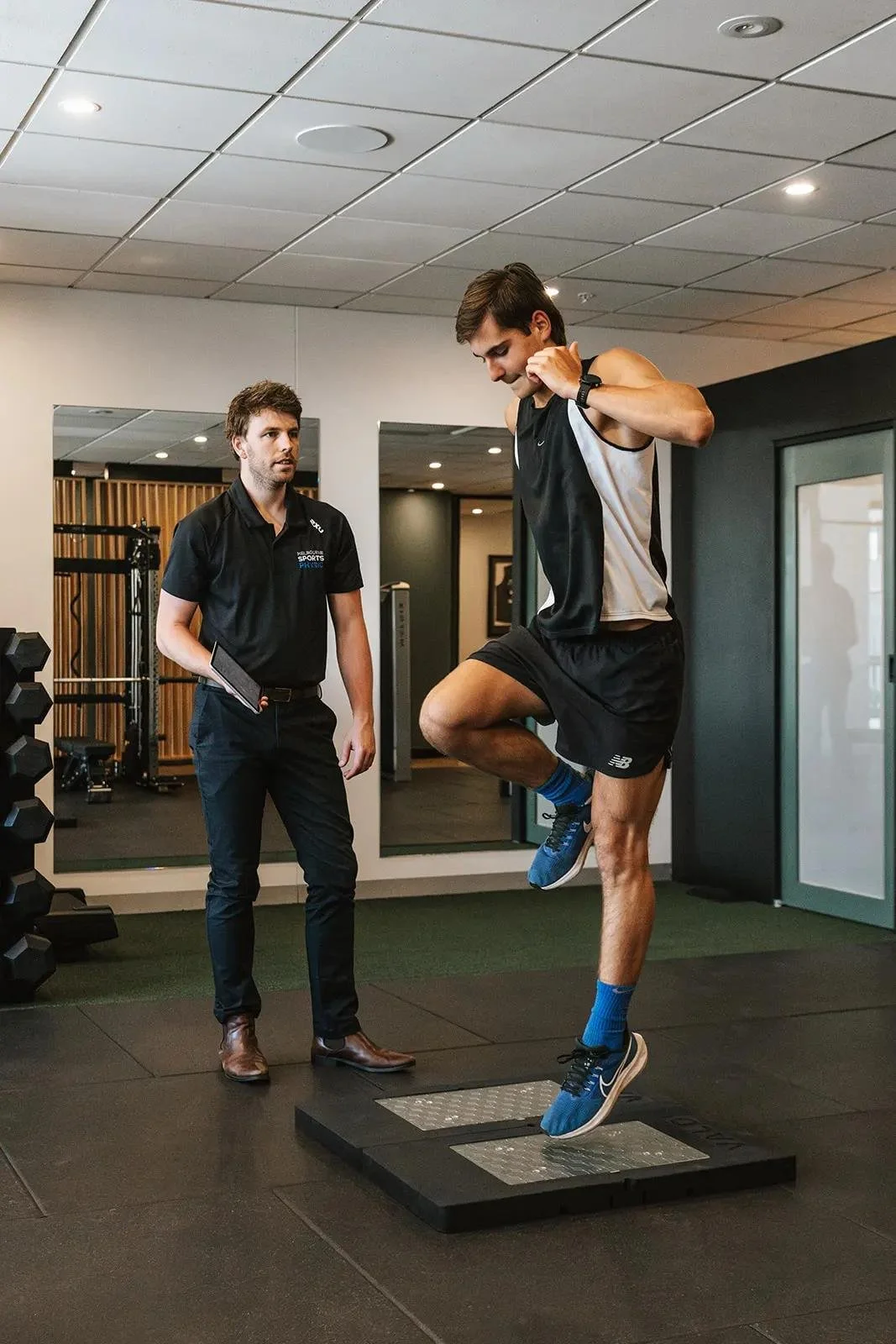
VALD testing for Single leg hop
Clinical assessment and functional testing can provide additional information about how the ankle is performing.
At Dynamic Physiotherapy, we can use VALD ForceDecks to assess factors such as force production, force absorption, balance, jumping capacity, and differences between limbs.
Testing can form part of a broader assessment alongside strength, movement quality, symptoms, confidence, and sport-specific performance.
Research into tools such as the Ankle-GO has also highlighted the potential value of combining patient-reported measures with functional testing when assessing return-to-sport readiness after a lateral ankle sprain.
The aim isn't to rely on one test or one number.
It's to build a clearer picture of whether your ankle is ready for the demands you're asking it to handle.
Final Thoughts
A lateral ankle sprain may feel like a minor injury once the pain settles, but returning fully involves much more than being pain-free.
Effective rehabilitation should progressively restore:
Mobility
Strength
Balance
Proprioception
Power
Movement control
Confidence
Whether your goal is returning to competitive sport, running, the gym, work, or everyday activity, your rehabilitation should reflect the demands of what you want to get back to.
The goal isn't simply to get your ankle feeling better.
It's to get your ankle ready.
How Dynamic Physiotherapy Can Help
At Dynamic Physiotherapy, we take an individualised approach to ankle rehabilitation.
Our physiotherapists can assess your injury, identify any remaining limitations, and develop a progressive rehabilitation plan based on your goals and activity demands.
From early-stage rehabilitation through to strength, plyometrics, sport-specific training, and objective testing, we'll help you build your ankle back up and work towards returning to the activities you enjoy with confidence.
Key Takeaways
📌 Feeling better doesn't necessarily mean your ankle has fully recovered.
📌 Rehabilitation should progressively challenge strength, balance, control, power, and confidence.
📌 Late-stage rehabilitation prepares the ankle for the speed, force, and unpredictability of sport.
📌 Return-to-sport decisions should consider pain, physical impairments, confidence, sensorimotor control, and functional performance.
📌 Objective testing can provide additional information to help guide rehabilitation and return-to-sport decisions.
📞 Ready to Get Back in the Game?
If you've rolled your ankle and are struggling to return to sport, running, the gym, or your usual activities, our team at Dynamic Physiotherapy can help guide your rehabilitation.
Book an appointment today and take the next step towards a stronger, more confident return.
References
Wagemans J, Bleakley C, Taeymans J, et al. (2022). Evidence-based treatment choices for acute lateral ankle sprain: a comprehensive systematic review. European Review for Medical and Pharmacological Sciences.
Smith MD, Vicenzino B, Bahr R, et al. (2021). Return to sport decisions after an acute lateral ankle sprain injury: introducing the PAASS framework—an international multidisciplinary consensus. British Journal of Sports Medicine, 55(22), 1270–1276.
Picot B, Lopes R, Rauline G, et al. (2024). Development and Validation of the Ankle-GO Score for Discriminating and Predicting Return-to-Sport Outcomes After Lateral Ankle Sprain. Sports Health, 16(1), 47–57.
Picot B, Fourchet F, Lopes R, et al. (2024). Low Ankle-GO Score While Returning to Sport After Lateral Ankle Sprain Leads to a 9-fold Increased Risk of Recurrence: A Two-year Prospective Cohort Study. Sports Medicine - Open, 10, 23.

Written by:
Mitchel Pennell
Physiotherapist | Dynamic Physiotherapy
If you’re recovering from a lateral ankle sprain and want a personalised assessment and rehabilitation plan, book an appointment with Mitch to take the next step towards getting back to: MOVE FREELY. TRAIN HARDER. PERFORM BETTER.