
Understand what causes a quad strain, how physiotherapy can help, and how progressive rehabilitation prepares your quadriceps for a safe return to sport.
A quad strain can affect everything from walking and climbing stairs to sprinting, jumping, and kicking.
Although pain and swelling may settle as the injury begins to heal, this doesn't necessarily mean your quadriceps have fully recovered.
Strength, range of motion, muscle function, and confidence can remain affected, particularly when returning to high-speed or explosive sporting movements.
For athletes, this is especially important. Sprinting, kicking, jumping, and changing direction place significant demands on the quadriceps, meaning rehabilitation needs to progress beyond simply getting out of pain.
Understanding the injury, following a progressive rehabilitation plan, and gradually rebuilding the demands of your sport can all play an important role in recovery.
What Is a Quad Strain?
A quadriceps strain occurs when one or more of the muscles at the front of your thigh become overstretched or sustain a tear.
The quadriceps muscle group consists of four muscles:
Rectus femoris: Helps flex the hip and extend the knee.
Vastus lateralis: Located on the outer portion of the thigh.
Vastus medialis: Located towards the inner portion of the thigh.
Vastus intermedius: Sits beneath the rectus femoris.
Together, these muscles help straighten your knee and contribute to movements such as walking, running, jumping, and kicking.
A strain can vary in severity, from a mild injury involving a small amount of muscle damage to a more significant tear that affects strength and function.
The location and severity of the injury can influence your symptoms, rehabilitation plan, and recovery timeline.
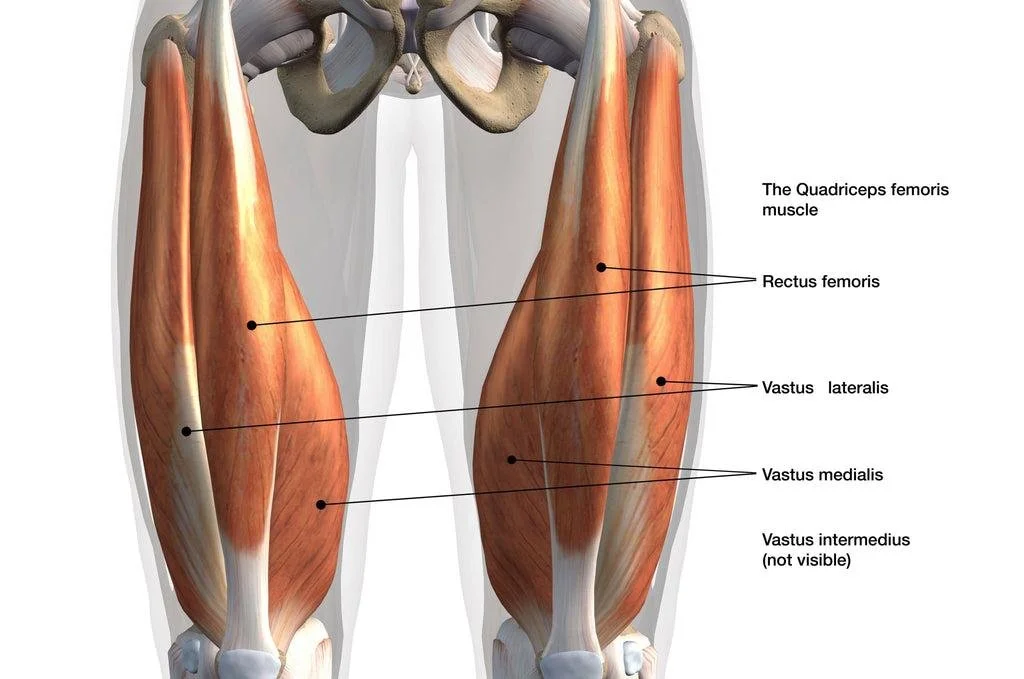
The quadriceps muscle group and its role in lower-limb movement.
How Does a Quad Strain Occur?
Quad strains commonly occur during activities that involve high force, speed, or rapid changes in movement.
These may include:
Sprinting and accelerating
Kicking a ball
Jumping and landing
Rapid changes of direction
Explosive movements during training or competition
The rectus femoris is particularly relevant in sporting movements because it crosses both the hip and knee joints.
During sprinting and kicking, it needs to manage rapid lengthening while producing force. The combination of speed, muscle lengthening, and high force can increase the demands placed on the muscle.
A strain may occur during a single explosive movement, although previous injuries, fatigue, training demands, and an individual's capacity to tolerate loading may also be relevant.
What Are the Signs and Symptoms of a Quad Strain?
Symptoms can vary depending on the severity and location of the injury.
Common signs may include:
Sudden pain at the front of the thigh
A pulling or tearing sensation during activity
Tenderness when touching the affected area
Pain when walking, running, or kicking
Discomfort when bending the knee or extending the hip
Reduced strength when straightening the knee or lifting the leg
Swelling or bruising in some cases
More significant injuries may cause difficulty walking or performing everyday activities.
It's important to remember that symptoms alone cannot reliably determine the severity of a strain. A physiotherapy assessment can help identify the likely injury, assess functional limitations, and determine whether further medical investigation is needed.
How Is a Quad Strain Assessed?
A physiotherapy assessment helps establish how the injury occurred, identify the structures involved, and guide an appropriate rehabilitation plan.
History and Observation
Your physiotherapist may ask about:
How and when the injury occurred
Whether you felt a sudden pull, sharp pain, or pop
The location and intensity of your symptoms
Previous quadriceps or lower-limb injuries
Your current training, sport, and activity demands
Observation may also include looking for swelling, bruising, changes in walking pattern, and difficulty performing everyday movements.
Movement and Strength Assessment
Your physiotherapist may assess hip and knee range of motion, quadriceps muscle length, knee extension strength, and hip flexion strength.
Testing is adjusted to your symptoms and the stage of your injury. More demanding movements may be introduced as your capacity improves.
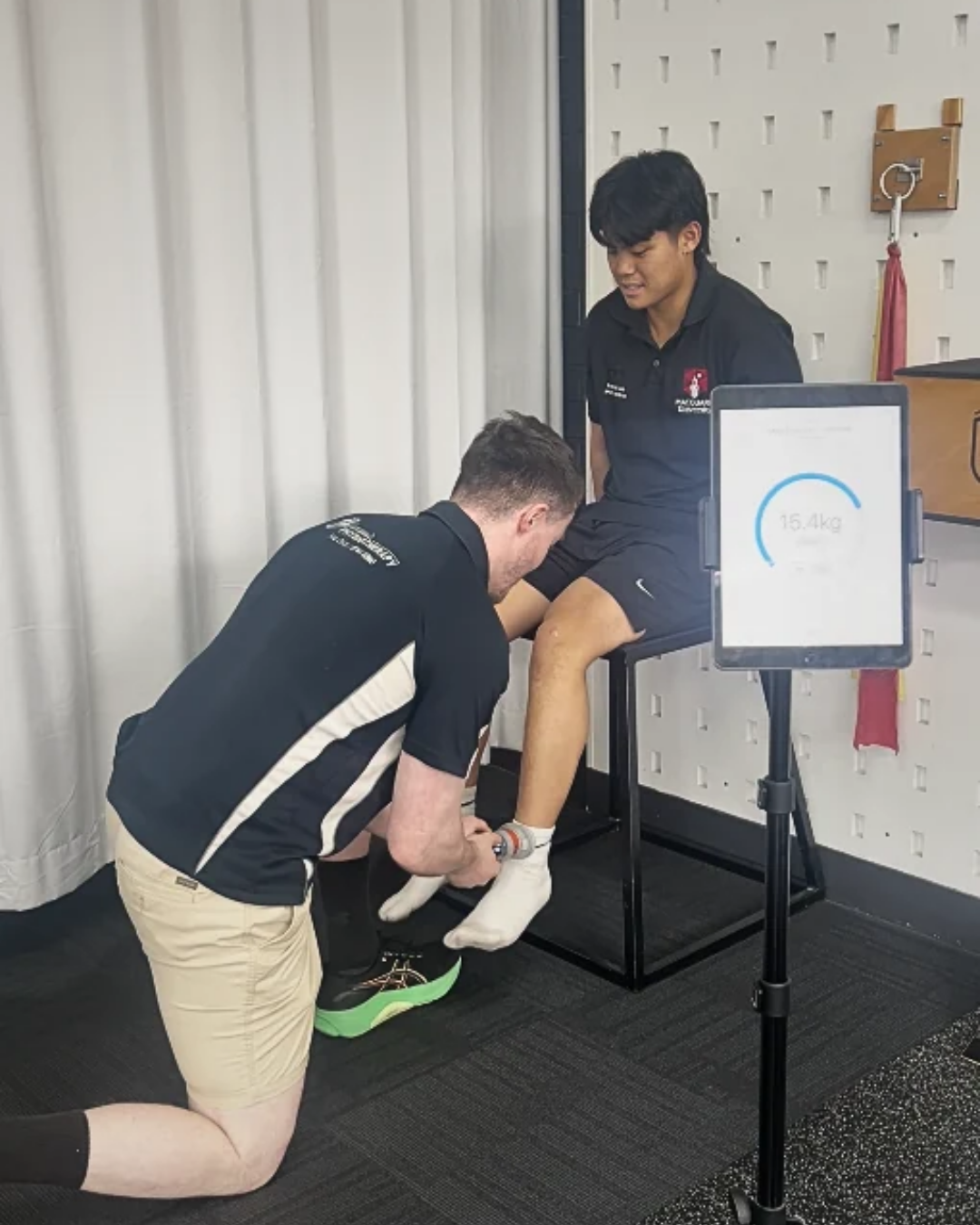
Physiotherapy assessment helps guide rehabilitation based on your symptoms, strength, and functional capacity.
Functional and Objective Testing
Depending on your presentation, assessment may also include functional movements and objective strength testing.
Examples may include:
Squats and single-leg movements
Seated knee extension testing
Resisted hip flexion
Range-of-motion measurements
Objective strength or force testing where appropriate
These findings help establish a baseline, identify remaining limitations, and guide progression throughout rehabilitation.
The aim is to understand not only what hurts, but also what your quadriceps can currently tolerate and what needs to improve before you return to your usual activities.
Quad Strain Treatment and Rehabilitation
Rehabilitation should be tailored to the location and severity of the injury, your symptoms, and the demands of your everyday activities or sport.
Rather than following a fixed timeline, progression should be guided by how your quadriceps respond to movement and loading.
Early-Stage Rehabilitation: Restoring Comfortable Movement
In the early stages, the focus is on managing symptoms and maintaining as much comfortable movement as possible.
Rehabilitation may include:
Adjusting activities that aggravate symptoms
Gentle hip and knee range-of-motion exercises
Pain-guided quadriceps activation
Isometric exercises where tolerated
Gradually restoring comfortable walking and everyday movement
The aim is to maintain movement and begin rebuilding muscle function without unnecessarily aggravating the injury.
The specific exercises and loading should be guided by your assessment and how your symptoms respond.
Early-stage rehabilitation focuses on comfortable movement and gradually restoring muscle activation.
Mid-Stage Rehabilitation: Rebuilding Strength and Capacity
As symptoms improve and the quadriceps tolerate more loading, rehabilitation can progress towards strengthening exercises.
Depending on your presentation, this may include:
Knee extensions
Squats
Split squats and Bulgarian split squats
Progressive resistance exercises
Hip and lower-limb strengthening
Gradually increasing exercise range, resistance, and volume
The goal is to rebuild the strength and capacity needed for more demanding movements.
Exercises should become progressively more challenging as your symptoms, strength, and function improve.
Feeling better during everyday activities is a positive sign, but it doesn't automatically mean your quadriceps are ready for sprinting, jumping, or competition.
Progressive strengthening helps rebuild the capacity needed for more demanding activities.
Late-Stage Rehabilitation: Preparing for Sporting Demands
For athletes, rehabilitation needs to prepare the quadriceps for the movements and forces encountered during training and competition.
Late-stage rehabilitation may include:
Running and acceleration drills
Progressive sprinting
Jumping and landing exercises
Plyometric training
Change-of-direction drills
Sport-specific movements, including kicking where relevant
The intensity, speed, and volume of these activities should increase gradually according to your strength, symptoms, and functional capacity.
For example, an athlete returning to a kicking sport may need to progressively rebuild kicking distance, speed, and volume rather than immediately returning to full-intensity kicking.
The aim is to bridge the gap between controlled rehabilitation exercises and the unpredictable demands of sport.
Your quadriceps need to be prepared to produce and absorb force at the speeds and intensities required by your activity.
Late-stage rehabilitation prepares the quadriceps for higher-speed, higher-force movements.
What Exercises Can Help With a Quad Strain?
The most appropriate exercises depend on the severity of the injury, your current symptoms, and how much loading your quadriceps can tolerate.
Rehabilitation exercises generally progress from restoring comfortable movement and muscle activation to strengthening, jumping, running, and sport-specific tasks.
Examples may include:
Early stage
Quadriceps isometric holds
Heel slides
Banded psoas marches
Straight leg raises, where appropriate
Middle stage
Squats
Bulgarian split squats
Progressive knee extension exercises
Trap-bar or other resistance exercises, where appropriate
Late stage
Double-leg and single-leg jumping
Hurdle jumps and landing drills
Lateral jumping exercises
Deceleration exercises
Progressive running, sprinting, and sport-specific drills
These are examples rather than a universal exercise sequence. Not every exercise is suitable for every quad strain, and the order of progression will depend on your individual presentation.
If an exercise causes a significant increase in pain or symptoms that persist afterwards, your loading or exercise selection may need to be adjusted with guidance from your physiotherapist.
The goal is to progressively increase what your quadriceps can tolerate, rather than rushing through a predetermined list of exercises.
When Can You Return to Sport After a Quad Strain?
Returning to sport shouldn't be based on time alone.
Although recovery timelines vary, being pain-free during everyday activities doesn't necessarily mean your quadriceps are ready for sprinting, jumping, kicking, or competition.
Return-to-sport decisions should consider a combination of symptoms, strength, movement quality, functional capacity, and the specific demands of your sport.
Important considerations may include:
Pain and symptoms: Can you complete relevant activities without significant pain or an ongoing increase in symptoms?
Range of motion: Has comfortable hip and knee movement been restored?
Strength: Has quadriceps strength improved sufficiently for your activity demands?
Power and function: Can you produce and absorb force during relevant movements?
Running and acceleration: Can you progressively tolerate higher speeds?
Sport-specific performance: Can you perform the movements required by your sport?
Confidence: Do you feel prepared to return to training and competition?
For kicking athletes, this may involve gradually rebuilding kicking distance, speed, and volume.
A graded return to training can help bridge the gap between rehabilitation and competition. Training exposure should increase progressively, with symptoms and performance monitored along the way.
There is no single test or universal strength threshold that guarantees a safe return. Your physiotherapist can help interpret assessment findings alongside your goals, sport, and current capacity.
Objective Testing: Measuring Strength and Function
Objective testing can help monitor strength and function as rehabilitation progresses.
Objective testing can provide additional information about how your quadriceps and lower limbs are performing throughout rehabilitation.
Where appropriate, tools such as VALD testing systems may help assess strength, force production, and performance during selected tasks.
Functional testing may also include jumping and landing assessments, alongside clinical strength testing and sport-specific movements.
These measures can help identify differences between limbs, track changes over time, and inform rehabilitation decisions.
However, test results should be interpreted in context. A single measurement or side-to-side comparison cannot determine return-to-sport readiness on its own.
Your physiotherapist will consider objective results alongside pain, range of motion, movement quality, confidence, training tolerance, and the demands of your sport.
The aim is to make rehabilitation progression more informed and individualised, rather than relying on time alone.
Can Quad Strains Be Prevented?
No prevention strategy can eliminate the risk of a muscle strain, but appropriate preparation and training may help athletes better tolerate sporting demands.
Useful considerations include:
Progressive strength training: Build quadriceps and lower-limb strength over time.
Gradual exposure to sprinting: Prepare for high-speed running rather than introducing large increases in intensity unexpectedly.
Sport-specific preparation: Practise relevant movements, including kicking, jumping, and changes of direction.
Appropriate training progression: Avoid sudden, substantial increases in training volume or intensity where possible.
Adequate recovery: Allow sufficient recovery between demanding training sessions.
Previous injury management: Ensure previous injuries have been appropriately rehabilitated before returning to full training.
The evidence for specific quadriceps-strain prevention strategies is limited, so these measures should be considered part of broader training preparation rather than a guarantee against injury.
Final Thoughts
A quad strain can affect more than just the front of your thigh. It can limit your ability to walk comfortably, train, sprint, jump, kick, and perform the movements required by your sport.
Effective rehabilitation involves more than waiting for the pain to settle.
A progressive approach should aim to restore:
Comfortable movement and range of motion
Quadriceps strength
Lower-limb function
Running and jumping capacity
Sport-specific performance
Confidence in movement
Whether you're returning to competitive sport, recreational running, the gym, or everyday activities, your rehabilitation should reflect the demands of what you want to get back to.
The goal isn't simply to get your quadriceps feeling better.
It's to rebuild the strength and capacity needed to move forward with confidence.
How Dynamic Physiotherapy Can Help
At Dynamic Physiotherapy, we take an individualised approach to injury rehabilitation.
Our physiotherapists can assess your quad strain, identify any remaining limitations, and develop a progressive rehabilitation plan based on your symptoms, goals, and activity demands.
From early-stage rehabilitation through to progressive strengthening, running, jumping, sport-specific training, and objective testing where appropriate, we'll help guide your recovery and work towards a confident return to the activities you enjoy.
Key Takeaways
📌 A quad strain occurs when one or more of the muscles at the front of your thigh become overstretched or torn.
📌 Symptoms and injury severity can vary, so a physiotherapy assessment can help guide management.
📌 Rehabilitation should progress from comfortable movement and muscle activation to strengthening and sport-specific activities.
📌 Returning to sport requires more than being pain-free. Strength, function, running capacity, and sport-specific demands also matter.
📌 Objective testing can provide useful information, but return-to-sport decisions should consider the overall clinical picture.
📞 Ready to Get Back in the Game?
If you're recovering from a quad strain or struggling to return to running, training, or sport, our team at Dynamic Physiotherapy can help guide your rehabilitation.
Book an appointment today and take the next step towards a stronger, more confident return.
References
Ishøi L, Krommes K, Husted RS, Juhl CB, Thorborg K. (2020). Diagnosis, prevention and treatment of common lower extremity muscle injuries in sport – grading the evidence: a statement paper commissioned by the Danish Society of Sports Physical Therapy (DSSF). British Journal of Sports Medicine, 54(9), 528–537. https://doi.org/10.1136/bjsports-2019-101228
Note: Evidence for the diagnosis, prevention, and treatment of muscle injuries varies in quality. Rehabilitation and return-to-sport decisions should be individualised according to clinical findings and the demands of the activity.

Written by:
Henry Hobson
Physiotherapist | Dynamic Physiotherapy
If you're recovering from a quad strain and want a personalised assessment and rehabilitation plan, book an appointment with our team to take the next step towards rebuilding your strength, returning to sport, and getting back to what you love.
MOVE FREELY. TRAIN HARDER. PERFORM BETTER.